


Each Generation is Unique in the Workplace – But Generosity’s Importance Unites Them
Friday, November 20th, 2026
What unites employees just starting their careers with those nearing the end of them? The 2026 Business Generosity Report found that across every generation, generosity is a common thread.
The report offers a full generational breakdown of survey findings across Gen Z, Millennials, Gen X, and Baby Boomers. This allows you to better predict how different parts of their workforce will respond to generosity, who will perform better, who will stick around, and who will become your strongest believers.
Generosity Unites the Workforce
When it comes to business generosity, the four generations are remarkably aligned. Employees at every career stage point to the same meaning of generosity: first and foremost, employee care that goes above and beyond. It’s the top answer for Gen Z, Millennials, Gen X, and Boomers alike, with little to no statistical difference (35–41%).
The same holds when asked whether their employer’s generosity has a significant impact on their day-to-day work experience; all four generations strongly agree at roughly equal rates.
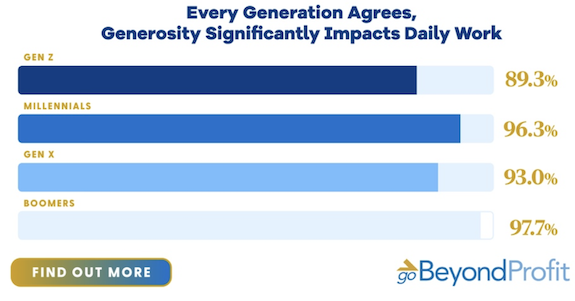
The alignment extends to one of the report’s biggest findings — how AI is impacting the workplace. When asked to name AI’s single biggest risk, all four generations name the same thing: loss of human connection and damage to company culture.
Generosity isn’t more important to one generation than another. But the differences that do exist offer valuable clues for predicting how your workforce will respond.
Gen Z (18–29): The Outlier Generation
Gen Z is the most motivated by generosity. They are far more likely to say they have actively pursued a job specifically because a company is generous and the most likely to have rejected an offer over a lack of generosity.
Part of what makes Gen Z’s response distinctive is that their priorities are uniquely their own:
- Company culture: Gen Z’s top priority is a workplace with different backgrounds, experiences, and points of view (38.8%); the other three generations rank leaders communicating openly highest.
- Business operations: Gen Z’s top priority is preventing child labor and human trafficking in the supply chain (42.9%). Every other generation puts genuine care for customers first, by a wide margin (52% of Millennials, 58% of Gen X, 70% of Boomers).
- Community giving: Gen Z’s top pick is financial contributions (43.3%); every other generation ranks PTO for volunteering or matching gifts higher.
Millennials (30–45): The Clearest Believers
As the largest share of the workforce right now, Millennials are most convinced generosity is effective at keeping them in a job. A remarkable 52.7% say they’ve stayed at a company specifically because of its generosity, even though they could have earned more elsewhere — the highest of any generation.
Their generosity priorities follow a consistent pattern. When it comes to community giving, PTO for volunteering is their top ask. For business operations, they value genuine care for customers, and when it comes to company culture, they want leaders who communicate openly.
Their response to the power of generosity shows up consistently:
- Impact on work performance: Millennials are the most likely generation to strongly agree that generosity has a “significant impact” on their day-to-day work (57.5%), and they outpace other generations when it comes to generosity’s impact on their loyalty, effort, engagement, and customer interactions.
- Belief in their own employer: Millennials tie Gen Z for the highest “Best in Class” ratings of their employer’s generosity (26.7% vs. 27.2%), far ahead of Boomers (7.0%).
- Pragmatic when it comes to cost: When their employer’s generosity investment holds steady rather than grows, Millennials credit their employer for maintaining investment because “employees value it” (38.8%).
Gen X (46–61): The Bridge, With One Distinct Position
Gen X rarely sets the extreme on any measure. When it comes to generosity they consistently take the middle ground between younger enthusiasm and Boomer skepticism. But on one question, they stand alone:
- Values aren’t guiding AI implementation: Gen X is the only generation to claim “we haven’t yet connected our values to our AI strategy” (31.5%) as their top response to current AI implementation effots. Every other generation is more likely to say their company is at least trying to let values guide those decisions, even if the effort can’t quite keep pace with how fast AI is moving. For Gen X, more than any other generation, the answer right now is no.
Baby Boomers (62–80): Skeptical of Their Employer, Convinced of the Idea
Boomers are more critical of their own employer, less likely to say generosity has shaped their career choices — and yet they are the most ardent believers once they’re convinced generosity is real.
- Most skeptical of their own employer: Only 7.0% of Boomers rate their employer “Best in Class,” against roughly 20–27% for every other generation.
- Least likely to let generosity impact career decisions: 39.5% say they haven’t made a single career decision — leaving, rejecting an offer, pursuing a job, staying, or taking a pay cut — because of a company’s generosity or lack of it. Boomers are the only generation where “none of these” is the single most common answer.
- The strongest payoff once convinced: 95.3% of Boomers agree that generosity affects their loyalty when they experience it as real — the highest of any generation.
What This Means for Your Workforce
This generational breakdown doesn’t change the core finding of this year’s report. For every generation, generosity (i.e., consistent, genuine care for people) significantly improves work performance across a variety of measures including productivity, collaboration, loyalty and engagement. For executives looking to fine tune their generosity efforts for their current or future workforce, the data offers guidance.
If retaining early- and mid-career talent is the priority, the Gen Z and Millennial data are the most directly actionable: both groups are highly motivated by generosity and make both career and financial decisions based on it. If the goal is building credibility with a more tenured, more skeptical workforce, the Gen X and Boomer data matter more. That audience needs to see the follow-through before they’ll credit the effort, but the payoff, once earned, is the strongest in the survey.
Either way, the underlying case for investing in generosity applies to everyone. No matter your workforce demographics, prioritizing generosity is a strategic imperative driving real business results.
Read the full generational findings in the 2026 Business Generosity Report →

